I like the brass era the best, but the rest are at http://www.retrovisiones.com/2014/12/la-evolucion-del-leon/
Tampilkan postingan dengan label informative. Tampilkan semua postingan
Sabtu, 04 April 2015
the evolution of the Peugot lion was well done on retrovisiones.com, from 1905 to 2015
I like the brass era the best, but the rest are at http://www.retrovisiones.com/2014/12/la-evolucion-del-leon/
In Queens, NY there are 9 intersections and 28 corners of 60th and 60th
From http://tywkiwdbi.blogspot.com/2015/03/lets-meet-on-corner-at-60th-and-60th.html
Kamis, 02 April 2015
The Durand-Lesley Propeller Collection
Fifty of the propellers are currently on permanent display in the Terman Engineering Library in the Huang Engineering Center. Others were sent to the Smithsonian Institution in Washington D.C
The work created a comprehensive methodology that was widely used by engineers but little studied by historians, until Walter G. Vincenti wrote about it as a case study in his book, “What Engineers Know and How They Know It: Analytical Studies from Aeronautical History” (1993).
The studies at Stanford systematically altered parameters that defined the shape of propeller blades, and two others - the speed of the airstream and the speed of propeller rotation, to determine the best performance of various propeller shapes.
The history of aeronautics at Stanford began long before the actual founding of the Aeronautics Department and is almost as old as the university itself. It all started with the appointment of William F. Durand in 1904 to the chairmanship of the Department of Mechanical Engineering, only a year after the first flight of Wilbur and Orville Wright.
While at Cornell University, Durand's research concerned boat design. He published the classic text Resistance and Propulsion of Ships in 1898. When he came to Stanford he began to study the then-nascent field of aviation. Working with Professor E.P. Lesley, Durand built one of the first wind tunnels and embarked on a rigorous study of propeller design that provided airplane makers with the means to choose the best propeller for their airframe designs. The study was notable for its results, and for bringing a more scientific approach to engineering research.
In the early 1930s, Durand edited the six-volume series, Aerodynamic Theory, a major reference in the field. Durand also shared his scholarship through public service, both as chairman of the National Advisory Committee for Aeronautics - a precursor of NASA - and during World War II, as a leader of a program to advance the development of jet engines.
His first professional assignment upon graduation from Annapolis was as engineering officer on the U.S.S. Tennessee, a full-rigged wooden ship with auxiliary steam power.
http://lib.stanford.edu/lotf/readings?page=0%2C450 and http://engineering.stanford.edu/2010-stanford-engineering-heroes
Rabu, 01 April 2015
Bangshift just did an article on the greatest cheating methods in racing
Some that impressed me,
Wimpy springs that would put the car on the bumpstops for the race and change the cars rake affecting the air dams position relative to the air flow over the car
someone in the stangs with a garage door opener remote that activated a mobile weight in the car that would move from one side to the other to increase traction in the inside of the turns
Smashing the race vehicle into the wall to make it narrower
Filling in a radio with lead to get the car up to weight
filling the frame with Mercury and having a transfer system so the car was level weight during tech, but all left bias during the race
James wrote in with a very vague "How bout the ole’ “nitrous system in the hood” trick. Leave the entire system mounted to the inside of the hood and use the hood pins to supply power and ground. Or a certain big name NASCAR team using seven cylinders of an eight cylinder engine on the restrictor plate tracks. They’d use the “unused” cylinder as an airpump to supply air to the remaining seven cylinders."
Tim Richmond’s team using a helmet filled with lead to go through tech and “forgetting it” in the hauler just before a race when a crew member would run back to get a real, lighter one was pretty clever.
Mopar super stock teams in the sixties would weigh the car with water filled tires and change tires before and after the race.
One NHRA drag racer was caught red handed with a small bottle of Nitrous Oxide http://www.caranddriver.com/features/blowup-feature in 1997
http://bangshift.com/general-news/bangshift-question-of-the-day/question-of-the-day-whats-the-strangest-way-to-cheat-in-a-race-that-youve-ever-heard-of/#comment-115475
Wimpy springs that would put the car on the bumpstops for the race and change the cars rake affecting the air dams position relative to the air flow over the car
someone in the stangs with a garage door opener remote that activated a mobile weight in the car that would move from one side to the other to increase traction in the inside of the turns
Smashing the race vehicle into the wall to make it narrower
Filling in a radio with lead to get the car up to weight
filling the frame with Mercury and having a transfer system so the car was level weight during tech, but all left bias during the race
James wrote in with a very vague "How bout the ole’ “nitrous system in the hood” trick. Leave the entire system mounted to the inside of the hood and use the hood pins to supply power and ground. Or a certain big name NASCAR team using seven cylinders of an eight cylinder engine on the restrictor plate tracks. They’d use the “unused” cylinder as an airpump to supply air to the remaining seven cylinders."
Tim Richmond’s team using a helmet filled with lead to go through tech and “forgetting it” in the hauler just before a race when a crew member would run back to get a real, lighter one was pretty clever.
Mopar super stock teams in the sixties would weigh the car with water filled tires and change tires before and after the race.
One NHRA drag racer was caught red handed with a small bottle of Nitrous Oxide http://www.caranddriver.com/features/blowup-feature in 1997
http://bangshift.com/general-news/bangshift-question-of-the-day/question-of-the-day-whats-the-strangest-way-to-cheat-in-a-race-that-youve-ever-heard-of/#comment-115475
1971 Challenger
there were only 250 with a 440 6 pack, no 440 4 barrels were installed in 1971 Challengers
Challenger Deputy was the base model, and came with engines from the 198 to the 383
The low priced Challenger Deputy (Option Code A93) was a mid-year introduction (March 1970) and continued until the end of 1971 model production.
This version of the Challenger was unique in several ways.
The car was similar to the base Challenger hardtop with the following exceptions ;
The rear quarter windows were fixed in place by leaving out the regulator and bolting the track.
The rear window winder was deleted and the hole plugged with a chrome button.
The standard engine was the 198 6 cyl. with the 225, 318 and 383 (2v and 4v) optional.
The seats were the cheaper standard Plymouth Barracuda seats in black or white only.
The steering wheel is coachman grain like the Barracuda.
Things like dual horns, cigar lighter and night/day rear mirror were optional.
There are only six Deputys known to have been built with the 383 4bbl engine.
Three with automatics and three with 4-speeds
http://www.cuda-challenger.com/cc/index.php?PHPSESSID=2a80dff8f346cedac1f470c0fa864e74&topic=48961.15
Challenger Deputy was the base model, and came with engines from the 198 to the 383
The low priced Challenger Deputy (Option Code A93) was a mid-year introduction (March 1970) and continued until the end of 1971 model production.
This version of the Challenger was unique in several ways.
The car was similar to the base Challenger hardtop with the following exceptions ;
The rear quarter windows were fixed in place by leaving out the regulator and bolting the track.
The rear window winder was deleted and the hole plugged with a chrome button.
The standard engine was the 198 6 cyl. with the 225, 318 and 383 (2v and 4v) optional.
The seats were the cheaper standard Plymouth Barracuda seats in black or white only.
The steering wheel is coachman grain like the Barracuda.
Things like dual horns, cigar lighter and night/day rear mirror were optional.
There are only six Deputys known to have been built with the 383 4bbl engine.
Three with automatics and three with 4-speeds
http://www.cuda-challenger.com/cc/index.php?PHPSESSID=2a80dff8f346cedac1f470c0fa864e74&topic=48961.15
Senin, 30 Maret 2015
Kamis, 26 Maret 2015
Chrysler test driver Buddy Baker took the No. 88 Dodge to a 200.447 world record. That vehicle is now inside a 73 Charger body
Above, the 200.47 Mph world record setting Daytona.
Below, what became of it as Nascar couldn't cope with such high speed cars with low tech tires that weren't up to a 500 mile high speed races, and so little in the way of safety at tracks to prevent racers from dieing in crashes. It was rebodied and forgotten, and spent around 30 years behind a garage in Iowa
Above, the original nose
Below, the plate between the radiator and the nose ended up as a splash guard
the original wing
the car in the International Motorsports Hall of Fame at Talledaga that represents the 200.447 record setter? Is another test mule that was going to be junked as it was of no use to anyone, so instead, it gets to sit in a museum in perpetuity.
Backing up this information was an inter-company correspondence memo written by G.W. Porter and dated July 31, 1970, which was uncovered by Tim Wellborn (director of the Talladega Museum) in 1997. Key parts of this memo include the following: "In May, we received a request from NASCAR relative to the possible donation of the subject car to NASCAR for their speed museum.... Contingent upon your approval, we will take our old No. 71 car, DC-74, paint it to look like the Engineering car No. 88 car, which we used in breaking the 200-mph speed record, and present it to NASCAR. This No. 71 car has outlived its usefulness and would be scrapped in the event we weren't to use it for this purpose."
read all about it at http://www.msn.com/en-us/autos/enthusiasts/1969-dodge-daytona-rare-finds/ar-AA9QEe0?ocid=U146DHP#image=5
Selasa, 24 Maret 2015
"Branded" Mustang special
Ford offered a dealer installed package called “Branded Mustang” in 1968 with patterned tops similar to the Mopar Mod Tops. There were two kits available, one for ’65-66 and one for ’67-68.
Branded edition Mustangs were created by dealerships on mostly used 65-68 Mustangs to spiff them up for resale. The Branding kit was available from Ford. The kit included choice of colored vinyl tops (in 15 colors), side stripes (in 5 colors), quarter panel chrome, and special Branded emblems.
the vinyl tops could be in four patterns - Paisley, Sculptured, Tweed, or Leather. They also came in 15 different colors. Or you could get just white or black. The stripes came in five different colors.
http://www.mustangandfords.com/featured-vehicles/mump-1212-brand-marketing-1967-mustang/photo-gallery/#9
The Branded Mustang Kit was used by dealers on new and used Mustang coupes and was distributed by DSI Corp., Plymouth, Mich. directly to Ford Dealers.
It consisted of:
1. Pre-cut, hand-sewn vinyl top - 15 different colors or patterns
2. Two black and brass or silver and black C-pillar emblems - marked left and right
3. Left and right Screw-On quarter moldings - with Ford part numbers
4. Pre-cut "Thoroughbred" stripes in five colors (Red, white, black, blue, gold)
5. Two cans of Mastic glue
6. Ford instruction guide
This all came in a 3 foot long shipping tube from DSI.
The tops are all different and range from 'pretty cool' to 'butt ugly'.
There also is a thoroughbred stripe identification chart.
images from http://mustangattitude.com/cgi-bin/specialmustang.cgi?year=1967&model=&smod=Branded&optn=&name=Branded%20Mustang
http://mustangattitude.com/cgi-bin/specialmustang.cgi?year=1967&model=&smod=Branded&optn=&name=Branded%20Mustang
Senin, 23 Maret 2015
Old Oak Common Engine Shed, 1906
A postcard depicting the roundhouse with vents for the steam locomotives... imagine the smog if they weren't venting those coal burners to outside of the building!
Found on https://www.facebook.com/HeritageRailway/posts/652462124858194
Rabu, 18 Maret 2015
the smart devils at Petrolicious, they did the perfect St Patricks Day post... of why Alfas had 4 leaf clovers on the hoods
You have to admire the precise thinking over at Petrolicious, no one else thought to post about this!
Read the article at http://www.petrolicious.com/more-than-luck-the-story-of-alfa-romeo-s-quadrifoglio-badge
But long story short, Alfa had 4 race car drivers on their first factory racing team, Enzo Ferrari, his friend Ugo Sivocci, Giuseppe Campari and Alberto Ascari. Sivocci was unlucky, and to boost his luck, he painted a quadrafoglio - four leaf clover - on his car before the 1923 Targa Florio.
Sivocci won the 1923 Targa Florio—and, apart from his talent behind the wheel, it seemed as though the Quadrifoglio helped win him the race.
Sivocci, who died during practice for the Italian Grand Prix at Monza before the symbol was painted on his Alfa Romeo P1 race car.
His death was recognized in a symbolic change to the Quadrifoglio: before Monza, the clover sat inside a white diamond, each point said to represent each of the Alfa Romeo factory drivers.
When Sivocci died, one of the points of the diamond was removed, creating the cloverleaf in a triangle emblem that continues to this day.
Kamis, 12 Maret 2015
rail inspectors were outfitted with Chevys, Fords, etc... the company President, though, he went full force and got a Caddy limo
New Haven Railroads lines managing director, Pat McGinnis.
Notice the vanity plates with his initials... he mush have been ridiculously wealthy
Found on https://www.facebook.com/HeritageRailway and photos from https://www.flickr.com/photos/that_chrysler_guy/4925148772/in/photostream/
http://en.wikipedia.org/wiki/New_York,_New_Haven_and_Hartford_Railroad
The New Haven Railroad operated in New England from 1872 to 1968, dominating the region's rail traffic for the first half of the 20th century. By 1912, the New Haven practically monopolized traffic in a wide swath from Boston to New York City.
The line went bankrupt in 1935, was reorganized and reduced in scope, went bankrupt again in 1961, and in 1969 was merged into the Penn Central system, which itself went bankrupt.
A reorganization was completed on September 18, 1947. Frederic C. Dumaine, Sr. and others, including Patrick B. McGinnis (1904-1973), gained control in 1948.
Frederic C. Dumaine, Jr. took over after his father's death in 1951 and immediately set about restoring the condition of the railroad and the morale of the employees. In 1953, control passed from the preferred stockholders to the common stockholders.
A proxy fight then ensued between McGinnis and incumbent president Dumaine; McGinnis emerged as the victor and sought to maximize revenue for shareholders.
To do this, he deferred maintenance and ordered experimental lightweight trains for Boston-New York service. Another McGinnis contribution was the imposition of parking charges at stations.
Hurricanes in 1955 washed out a number of important lines. Upon McGinnis' departure for the B&M in 1956, auditors found the NH earnings for 1955 were less than half of what McGinnis had claimed.
McGinnis' financial dealings ultimately culminated in a prison sentence for receiving kickbacks on the sale of B&M's streamlined passenger cars, ending his career in railroading.
Selasa, 10 Maret 2015
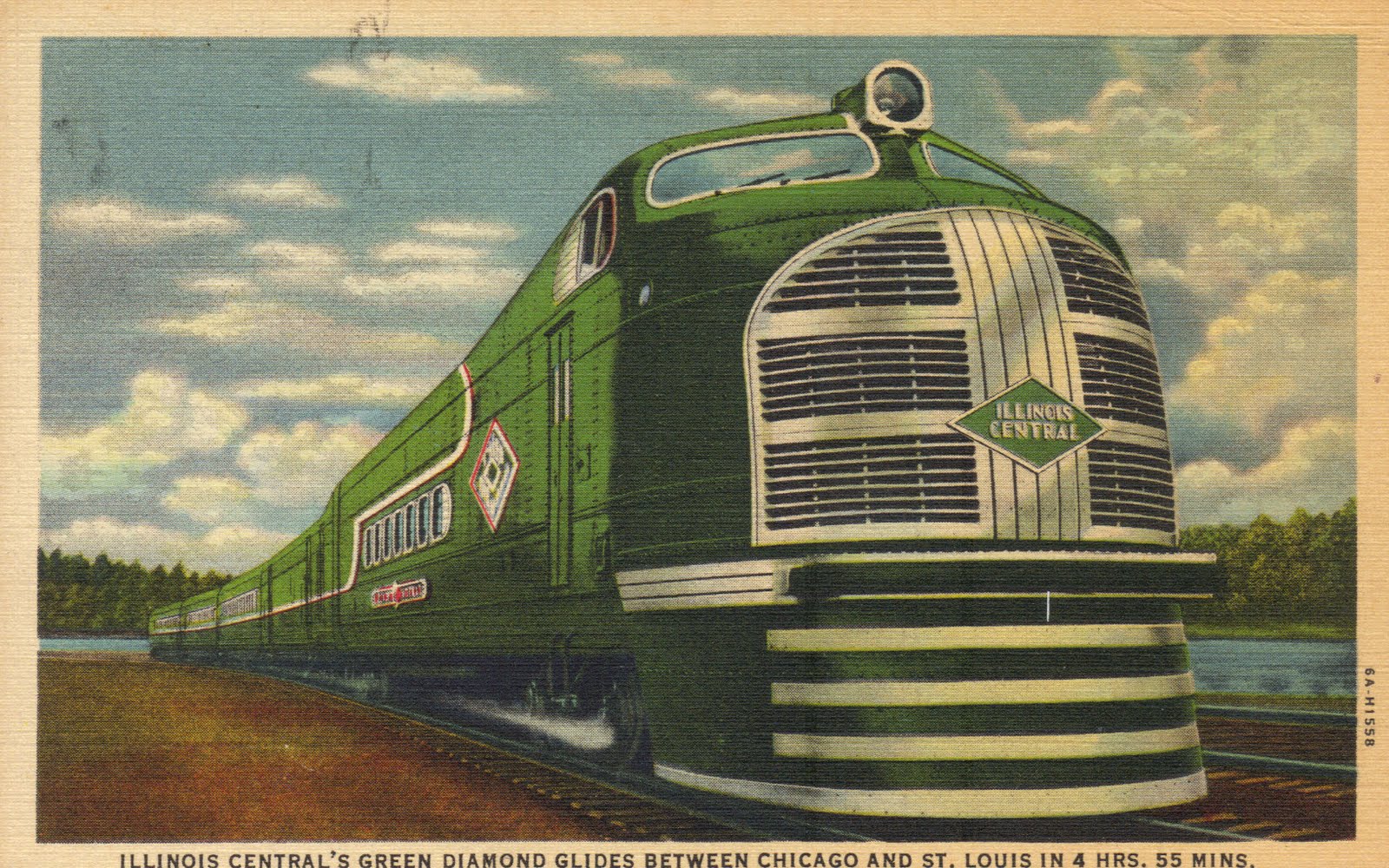
Illinois Central Green Diamond streamliner,
The Illinois Central's first streamlined passenger train proved popular with the traveling public between Chicago, and St. Louis on the Illinois Central Railroad. It operated from 1936 until 1968.
The name honored the "green diamond" in the Illinois Central's logo as well as the Diamond Special, the Illinois Central's oldest train on the Chicago-St. Louis run.
Like the second-generation City trains which it resembles, the Green Diamond was built by Pullman, but was made of Corten steel rather than aluminum. Pullman constructed the Green Diamond's original fixed consist, which included a power car, baggage/mail car, coach, coach-dinette, and kitchen-dinette-parlor-observation car. The coach seated 56, while the coach-dinette seated 44 in the coach section and the dinette area had seating for 16. The parlor car had seating for 22.
It was the last fixed-consist train built in the 1930s for a railroad in the United States. The train's interior was art deco, as was popular in the period.
Found on https://www.facebook.com/HeritageRailway?fref=photo
http://www.rediff.com/money/slide-show/slide-show-1-historic-and-iconic-images-of-train-journey/20120830.htm#28
Found on http://streamlinermemories.info/?p=2351
http://streamlinermemories.info/Eastern/GreenDiamond.jpg
Senin, 09 Maret 2015
The first satellite news truck, Conus-1, is already a museum piece, but it was vitally important to the 80's growth of news broadcasting on cable tv
restored by the B R Howard company, it was built on an F350 van chassis, which couldn't handle the weight, and then built on an '84 GMC truck frame because additional components added to the vehicle (control center, cargo bed, and a hydraulic satellite disk boom) were heavier than anticipated.
Satellites were key to tv affiliate stations getting news to and from the networks (ABC, CBS, NBC, CNN) which broke the networks control over the news stories that were selected. In covering breaking news, local stations have the variety of resources to choose from of networks or affiliates. If you are interested enough you can read all about it I learned a bit from this Google book
Photo from http://www.brhoward.com/conus_satellite_truck.html
an actual dynamite stick bombed car, that sets your respect for investigation reporters up a long way. The story of Dan Bolles
After getting his college degree and being so awesome the President of the university gave him an award just for being him, he fought in Korea. When he came back home he parlayed his lack of fear of enemy aircraft into a job taking on the mafia. He began writing for the Arizona Reporter, and developed a reputation because he actually reported the terrible things people were doing.
While investigating a real estate deal between the mafia and politicians in Phoenix in 1976, a remote controlled dynamite bomb was detonated, and after 10 days and many surgeries and amputations, the very dedicated reporter, Dan Bolles, was able to declare the dying words “They finally got me, the Mafia. Emprise. Find John.” and the John in question, John Harvey Adamson, was found guilty of planting the bomb, though the man who ordered the hit wasn’t imprisoned for decades. An entire gallery in the museum of news and journalism (The Newseum in Washington) is dedicated to Bolles’ work and memory.
Info and photo from http://www.weirdworm.com/5-journalists-who-gave-everything-for-the-story/ via the story I found on http://www.brhoward.com/don_bolles_car.html who has stopped the natural decay of the car and made it look the way it did on the day in 1976 for it's exhibition in the Washington DC museum of News and Journalism http://www.newseum.org/about/
Photo and post idea from http://www.brhoward.com/don_bolles_car.html
Jumat, 06 Maret 2015
Gandy dancers and gross polluters, the killers of the street cars
image from http://latimespast.tumblr.com/post/96562548684/the-planned-downtown-l-a-streetcar-is-back-in-the
the federal government sued the consortium of General Motors, Standard Oil, Firestone Tire and Rubber, Phillips Petroleum, and Mack Truck Manufacturing Co. for conspiring to deep-six the region's streetcars.
Most historians agree that GM and the other mega-companies only helped to speed the end of the railway, which already was deep into red ink.
World War II's shortages of gasoline and rubber crippled bus service. By the end of the war, the trolley lines were decrepit, obsolete and deep in the red. Some Angelenos purchased the trolleys from scrap dealers, moved them to vacant lots and began living in them during the city's housing shortage.
In 1945, American City Lines, a subsidiary of National City Lines, a Chicago-based company whose investors included General Motors and other big oil and rubber interests, bought the remaining electric streetcar line in LA.
National City Lines soon controlled 46 transit networks in the Midwest and West. The company began scrapping these electric systems and replacing them with diesel buses that -- surprise -- used fuel and rubber.
By 1946, the Justice Department had caught on. It filed an antitrust suit against National City Lines for conspiracy to monopolize the transit industry. But before the suit came to trial in Chicago, the consortium of big companies bailed out, selling their holdings in National City Lines. That essentially left it as an empty corporation.
In 1949, the case finally came to trial. The verdict was mixed, with acquittals and convictions. Although they no longer owned National City Lines, the companies in the consortium were fined wrist-slapping amounts of $5,000 each, while individual company officials were fined $1 each, for a total of $37,007. By then, the far-flung suburbs were crisscrossed by cars, highways and a few freeways, and the so-called conspiracy plot simply applied the coup de grace to a dying system.
http://www.latimes.com/me-2003-los-angeles-streetcar-history-story.html#page=1
LA, 1943 http://latimespast.tumblr.com/post/81704529173/downtown-los-angeles-70-years-ago-this-is-the
Rabu, 04 Maret 2015
during WW2, Baldwin was building both Sherman tanks and steam locomotives
In this 1943 company photograph, two different war product lines are shown, a brand new Duluth, Missabe and Iron Range “Yellowstone,” one of the largest steam engines produced, along with an M4 Sherman tank. This view is from the Railroad Museum of Pennsylvania’s collection
Found on https://www.facebook.com/HeritageRailway?fref=nf
Selasa, 03 Maret 2015
Senin, 02 Maret 2015
You've heard that Volvo was bought by a Chinese company? So, new Volvos... are no longer the Swede you've known for safety, they are now Zhejiang Geely manufactured. Here are the other "who owns what" of 2015
GM
GM produces vehicles in 37 countries under 13 different brand names. These are Alpheon, Buick, Chevrolet, GMC, Cadillac, Holden, HSV, Opel, Vauxhall, Wuling, Baojun, Jei Fang and UzDaewoo.FORD
A Ford is a Ford is a Ford. Unless, of course, it’s called a Lincoln.
PSA
Citroën, Peugeot and DS.
HONDA
Japanese automotive company Honda and Acura.
TATA
The Indian company makes Tata, Land Rover and Jaguar.
RENAULT
French manufacturer Renault also markets the Dacia from Romania and cars bearing the Renault Samsung badge
NISSAN
As well as Nissan, Infiniti and the Datsun nameplate for low-cost vehicles, it owns UD trucks
FCA
Alfa Romeo, Lancia, Ferrari and Maserati, while the Chrysler operation is responsible for Jeep, Ram and Dodge.
DAIMLER
It is now the governing company name for both Mercedes-Benz and Smart, Detroit Diesel, Mitsubishi, Fuso, Maybach, Freightliner, Western Star,
BMW
The BMW Group controls Mini and Rolls-Royce
TOYOTA
Toyota, Hino, Lexus, Ranz and Scion. It also holds a controlling interest in Daihatsu
HYUNDAI
Hyundai owns fellow South Korean car company Kia.
VOLKSWAGEN
The company also control Porsche, Bugatti, Lamborghini, Audi, Bentley, Skoda and Seat
GEELY
Geely also owns the revitalised Volvo brand.
Langganan:
Postingan (Atom)


.jpg)


.jpg)